
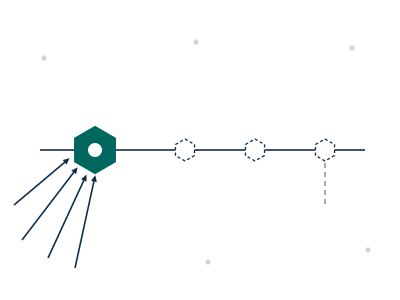
At the beginning of an undertaking there is a problem and an idea of what might help against it. Which option holds, what it costs, how long it takes, where it meets resistance: much of that is still open. Uncertainty is never again as large as at this point, and no amount of preparation dissolves it here, because the knowledge only comes from doing the work.
This is exactly what project methods are built for. You begin small, with an initiation phase that examines options and commits to nothing it cannot yet know. Then somebody decides whether the work continues. With each phase the solution sharpens and the uncertainty shrinks, and at each phase transition the question is put again. One of the possible answers is discontinuation. HERMES, the project management standard of the Swiss federal administration, gives the early termination of a project a task of its own: “The decision on project discontinuation is made before the set objectives have been achieved.” The method provides for a checklist, a final assessment and the capture of project experience.
This stepwise approach only works if an organisation can bear the uncertainty at the start. That is where the problem sits. Anyone who approves the money wants to know what will come out of it. How strong that wish becomes depends less on the size of the sum than on the organisation, and more precisely on who will later have to justify a discontinuation and face the consequences. So the certainty is demanded before the start, as much of it as possible, at the very moment when there is least to know.
Why the wish is so strong is written down in the same HERMES document: “The generally unpopular step of a project discontinuation lies entirely within the competence and responsibility of the project sponsor.” The method knows this decision is unpopular and says so. It lays down who may take it. What it costs the person who takes it, the method does not lay down. The person who stops an undertaking puts on record that money was spent without the promised result appearing. There is no procedure that records this as an achievement. There is one that asks about responsibilities.
People avoid that procedure in two places: before the start and after it. Both times it looks like diligence.
Avoiding It Before the Start: Pulling the Preparatory Work Ahead of the Approval
What is demanded is the result of the initiation phase before the initiation phase has been approved. Intended benefits, figures, the planned solution, the schedule, all of it is supposed to be in the application. And it is delivered. So the phase happens anyway, only without a mandate and without a budget. I call it the shadow initiation phase.
What it does not produce is a decision the procedure recognises. It ends with an application. If that gets through, the official initiation phase starts for an undertaking that has long been alive in people’s minds, carrying promises, expectations and a history. The decision meant to serve as the cheap exit is called project release in HERMES. It closes the initiation phase, is taken by the project sponsor together with the permanent organisation, and it can equally be to submit the undertaking again later or to end it altogether. After a shadow initiation phase, that point arrives too late. A no there would mean discontinuing something that was discussed and settled long before.
I have seen this happen several times at first hand, in funding applications and project proposals, and I set it down here as an observation. What follows from it, by contrast, is well researched.
The requirements for approval grow as long as the need for reassurance grows. In the end the preparatory work reaches the size of a small project before the project is approved. Both sides are doing their job: the people examining the application want to know what they are committing to, and the person writing it wants to be able to begin.
Above all, the shadow initiation phase supplies apparent certainty. Anyone who wants to start and has nothing solid to go on yet makes the figures fit. An initiation phase produces estimates that become more precise with each phase. Because these estimates sit in an approved application, they are read as a promise. What gets measured later is the promise.
The figures cannot deliver what they promise. By the logic of the procedure they would not have to at this point.
Bent Flyvbjerg has given this a name. In his overview of the most common biases in project management, strategic misrepresentation comes first, ahead of optimism: the deliberate and systematic distortion of information for strategic purposes. Costs are set low, benefits high, uncertainties disappear into wording.
What is in the application binds. David Ullman described a curve for engineering design that applies here just as well: knowledge about an undertaking grows as the work proceeds, while design freedom narrows at the same time. An application that fixes objectives, figures and solutions in detail moves those fixed points to the point of least knowledge. Departing from them afterwards is no longer learning, it is the correction of an approved document.
Flyvbjerg and Gardner argue for slow planning and fast building, by which they mean cheap experimentation with models and trials you can throw away. The shadow initiation phase is expensive planning that may not be thrown away, because it is the basis of the approval.
Avoiding It Afterwards: Pressing On
Once the undertaking is under way, the question shifts. Now it is about costs already incurred. Barry Staw described the pattern in 1976 and gave it the name it carries today: escalating commitment to a chosen course of action. Keil, Mann and Rai measured it in information systems projects and found that between 30 and 40 per cent of them show some degree of escalation.
The comfortable story about this has somebody clinging to a hopeless project against their better judgement. Mostly that is not what happens. Two things are missing: certainty and information. Whether an undertaking can still be saved is something nobody knows for sure halfway through. And what is known often fails to arrive where the decisions are taken. Smith, Keil and Depledge gave this a name, the mum effect: people who hold bad news about a project are more likely to keep it to themselves the more they fear the reaction.
What that looks like on the record can be read in Switzerland. The INSIEME information technology project of the Swiss Federal Tax Administration (ESTV) ran from 2001 and was discontinued in September 2012 by the then head of the Federal Department of Finance. By then it had cost 115.9 million Swiss francs. On the reporting, the finance and audit committees of parliament recorded in 2014, in my translation from the German: “The documents in part did not reflect the true circumstances, and the ESTV put INSIEME in too favourable a light, either by glossing over problems or by promising improvements.” Added to that is their finding that the recipients of those documents asked no further questions. This is the mum effect in a federal report.
What INSIEME does not demonstrate matters too. The discontinuation itself was right, and what the committees criticised was leadership and oversight, not the decision to stop. Something else is documented, and it counts for every future decision maker: the stop set off a two-year oversight procedure that ended in a public report naming responsibilities. Stopping starts the procedure that asks about blame. Carrying on does not.
Why Both Manoeuvres Need the Same Document
The two patterns are usually handled separately, one as a complaint about bureaucracy, the other as behavioural economics. The connection is the application.
It comes about because a no is expensive later, and it therefore contains figures that look firmer than the knowledge behind them. Those same figures make the late no more expensive still. A discontinuation then says not only that the thing did not work, it also says that the document the approval rested on was never sound. The demand for certainty produces the document that blocks the exit it was meant to prevent.
What Aviation Has Solved, and What It Has Not
The safety world knows this problem from the final approach. An unstable approach calls for a go-around. The go-around is the institutionalised form of discontinuation: permitted, expected, practised, free of sanction, laid down in the procedures.
It only half works. In its final report the Flight Safety Foundation records that 95 to 97 per cent of crews whose aircraft is in that state continue the approach to landing, and calculates that a decision to go around could prevent roughly half of all accidents. Ben Berman and Key Dismukes examined nineteen accidents for NASA and concluded that almost any experienced crew with the same knowledge would have decided similarly. They call it plan continuation bias: the closer the goal, the stronger the pull to stay with the plan.
The rule for discontinuation has existed in aviation for decades, with training, checklists and callouts. It is not enough. If it is not enough there, where a discontinuation costs twenty minutes, then the line in the project method is certainly not enough, where it can cost a career.
What Would Have to Look Different at a Gate Decision
Three things follow, and none of them is a tool.
First, discontinuation criteria belong in the application, not in the crisis. Setting down beforehand what would show that the undertaking is not working turns the later no into keeping an agreement. That only holds if the criteria come from honest preparatory work and not from the application that wants to be approved.
Second, the gate decision must not rest with the people whose application is under discussion. HERMES puts it with the project sponsor, which is right, but it solves the problem only if that sponsor is not the same person who presented the undertaking to the committee.
Third, an early discontinuation has to show up as a result and not merely as a write-off. Five million that prevented a hundred-million blind alley is an achievement that appears in no set of accounts. That it can be done differently is shown by the US Department of Veterans Affairs, which halted forty-five IT undertakings at once in 2009 and made their resumption conditional. A stop there was an administrative act, not a scandal.
The method is not the problem. It knows about discontinuation, lays down who is responsible and even calls the step unpopular. What is missing is a procedure in which stopping counts as an achievement and not a confession. As long as it is missing, every organisation will go on requiring that an undertaking be thought through to the end before it is allowed to begin. And they will wonder why their projects so rarely fail and so often simply never finish.
Thoughts on this? Take it to LinkedIn.
No comments here – but discussion is welcome, where the readership is anyway.
Join the discussion on LinkedInSources
- HERMES 2022 – Decide on Project Discontinuation, task description, hermes.admin.ch (main source)
- HERMES 2022 – Phases and Milestones and Decide on Project Release, hermes.admin.ch
- Barry M. Staw – Knee-deep in the Big Muddy: A Study of Escalating Commitment to a Chosen Course of Action, Organizational Behavior and Human Performance 16(1), 1976
- Mark Keil, Joan Mann & Arun Rai – Why Software Projects Escalate: An Empirical Analysis and Test of Four Theoretical Models, MIS Quarterly 24(4), 2000 (main source)
- H. Jeff Smith, Mark Keil & Gordon Depledge – Keeping Mum as the Project Goes Under: Toward an Explanatory Model, Journal of Management Information Systems 18(2), 2001
- Bent Flyvbjerg – Top Ten Behavioral Biases in Project Management: An Overview, Project Management Journal 52(6), 2021 (main source)
- Bent Flyvbjerg & Dan Gardner – How Big Things Get Done, Currency 2023
- David G. Ullman – The Mechanical Design Process, McGraw-Hill 1992
- Ben Berman & R. Key Dismukes – Pressing the Approach, Aviation Safety World, December 2006
- Flight Safety Foundation – Go-Around Decision-Making and Execution Project: Final Report, March 2017 (main source)
- Finanz- und Geschäftsprüfungskommissionen der eidgenössischen Räte (finance and audit committees of the Swiss parliament) – Informatikprojekt INSIEME der Eidgenössischen Steuerverwaltung, report of 21 November 2014, BBl 2015 6377 (main source)