
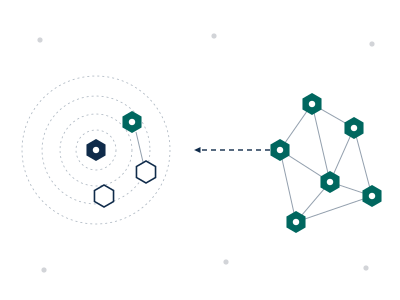
The canton of Zurich has two professional fire brigades, in Zurich and in Winterthur. Every other brigade in the canton is staffed by volunteers who turn out alongside their day jobs, paid a modest allowance per drill and call-out. So when a barn with animals in it catches fire somewhere in the canton at three in the morning, the organisation that responds has a composition nobody knows at that moment. The alert goes out, and only afterwards does it emerge how many are coming, how quickly they will be there, and which functions are among them: a breathing apparatus wearer, a pump operator, somebody with command training.
This is not a fault in the system. It is its normal form.
I find that more remarkable than it is generally taken to be in Switzerland, for a reason that has little to do with fire services and a lot to do with organisations. Every organisation on which safety research built its models knows its crewing before the shift begins. Air traffic control has a duty roster. The hospital has a rota. The aircraft carrier has a crew that is aboard because it has nowhere else to go. A volunteer brigade learns its capacity in stages. Who reaches the station first, who follows a few minutes later, who cannot come at all today: that resolves itself over the opening minutes, while the incident is already under way.
What the System Demands
Reinforcement is organised. Neighbouring brigades follow on, regional support brigades bring specialist equipment, and depending on the situation professional brigades arrive with what a local brigade does not hold, from a drone team on standby to equipment for chemical incidents. Then police, ambulance service and other partners. But reinforcement is a promise with a travel time attached. The opening phase belongs to the local unit. It is the period in which least is known, the situation develops fastest and the most consequential decisions are taken. Where the lines go in. Whether anyone enters. Whether the animals come out or the building is given up.
This produces a property I have not found described in any account of high reliability: the volunteer system deliberately puts its least practised unit where the uncertainty is greatest. Professional systems try to bring their strongest resource to the place where decisions are made. A volunteer system cannot do that and has to solve the task anyway.
Some sense of scale. In 2024 Switzerland counted 77,126 fire service members, which attended 81,824 incidents totalling 958,470 operational hours. More than 1,100 organisations, the overwhelming majority of them volunteer-staffed. Between a busy local brigade in a suburban municipality and a small one with a few dozen incidents a year lie worlds of experience. The range of work is the same for both. The barn in the example is statistically more likely to be in the small brigade’s area.
Resilience Out of Necessity
Before this sounds like a design flaw: it is not one. It is a trade-off, and in practice the only way it can be resolved.
Professional fire cover everywhere is not affordable, and hardly any country provides it. In Germany at the end of 2023 there were around 1,028,000 members of the volunteer fire services against some 39,500 professional firefighters. In the United States, of a good million firefighters roughly 635,000 are volunteers, four in five departments are all or mostly volunteer, and the National Volunteer Fire Council puts the value of that work at close to 47 billion dollars a year. The volunteer system is therefore not a Swiss budget version of a proper fire service. It is the worldwide normal form, because nobody can pay for the alternative.
So the adaptive capacity this essay is about was not a goal at the outset. It was a constraint. Nobody sat down and did resilience engineering. Somebody had to produce readiness across a whole territory on a fraction of the resources, and what comes out of that has to be adaptive, because otherwise it does not work at all. If you do not know how many people are coming, you cannot build an organisation that assumes a fixed number.
That is why this is worth looking at closely. Nothing is missing here. For over a hundred years this system has solved something that other organisations run programmes to address.
What the Literature Assumes
Weick and Sutcliffe developed the five principles of high-reliability organisations on aircraft carriers, in nuclear power stations and in air traffic control. I placed those principles in context in a book note in June and consider them sound. They do assume something that is easy to miss, because in the settings studied it went without saying. Mindfulness as a collective practice needs a collective that has practice. Sensitivity to operations needs people who work in operations every day. Deference to expertise needs expertise that has shown itself in shared work and is therefore known.
A volunteer brigade has little of this. It does train properly, and I do not want to talk that down: as a rule ten to twelve crew drills a year, plus breathing apparatus, pump operator and officer training depending on the brigade and the function, all of it alongside a full-time job. Against the presence of a professional brigade this is still a fraction. And the situation on the incident ground does not negotiate that difference.
Weick’s Own Counter-Case
The interesting point is that the answer lies with Weick himself, only in a different text. Anyone invoking HRO today quotes the five principles. The paper standing next to them is rarely read with them.
In 1949 fifteen smokejumpers parachuted into Mann Gulch in Montana and met a fire guard who was already on the ground. The group had little shared history, many did not know each other, and their foreman was a stranger to them. When the fire ran up the gulch and he gave an order nobody understood, the role structure fell apart, and the group fell apart with it. Thirteen men died, not because they were incompetent, but because at the moment the structure gave way they were only individuals.
From this Weick draws four sources of resilience for groups without continuity: improvisation from what is at hand, a virtual role system that exists in the head of every participant and therefore keeps running even when individuals drop out, an attitude that treats one’s own knowledge as provisional, and respectful interaction. This is not a watered-down version of the five principles. It is a different answer to a different starting position, and that starting position is the volunteer brigade’s.
Positions, Not People
What this looks like in practice was studied by Bigley and Roberts in 2001 at a Californian fire department. Their subject was the incident command system, and their finding is that bureaucracy and flexibility need not exclude each other, provided the bureaucracy defines positions rather than assigning people.
The first to reach the incident ground takes command. Not the most senior, not the most experienced, the first. The organisation grows from there, with further positions filled as soon as somebody is present who can fill them. Decision authority migrates to where the knowledge sits, while the formal hierarchy remains untouched: whoever knows the installation says what happens to the installation, and the incident commander stays incident commander.
The structure does not ask who will come. It defines which positions exist and fills them as people arrive.
There is also a distinction I regard as the most valuable contribution of that study. Improvisation on the incident ground is not merely permitted, it is designed in, but it has a hard boundary. Bigley and Roberts call legitimate deviation “constrained improvisation” and the illegitimate kind “freelancing”: the behaviour of people doing something sensible that nobody ordered and nobody is coordinating. The difference does not lie in competence. It lies in whether the action stays connected to the shared objectives.
This is exactly what makes the structure portable. It works with people who are not rehearsed, because it does not rely on rehearsal.
A second mechanism comes into play when larger incidents bring together organisations that have never trained with each other. Meyerson, Weick and Kramer coined the term swift trust for this: in temporary groups, trust runs through categories rather than shared history. Uniform, rank markings, radio discipline, shared terminology, the same command procedure. Within a canton this standardisation reaches a long way. How far it carries beyond that varies.
This migration of authority does have a weak point, and it shows at the handover of command. That the first on the ground takes command is laid down in the regulations. What happens when a professional or regional support brigade arrives later, with an incident commander who brings more experience and more equipment, is less so. There are commanders who want to take the incident over. Others see their role as supporting. And there are those who advise and stand by quietly as long as the local commander has the situation in hand. Authority can migrate towards knowledge, and it can just as easily migrate towards rank or towards a confident manner, and which of the two happens is not settled by any regulation.
Capabilities Nobody Trained
There is a resource that appears in none of these studies. A volunteer brigade contains people with civilian occupations: electricians, forestry workers, farmers, medical staff, tradespeople of every kind. The organisation never trained this knowledge and often does not even hold a full record of it.
Deference to expertise, in Weick, means listening to the operationally experienced. In a volunteer brigade it means using knowledge that has nothing to do with the fire service and explains everything at the decisive moment. The farmer knows how animals move in panic and where the openings in the barn are.
You cannot plan with this. Whether the person carrying that knowledge turns out tonight is chance. All you can do is prepare yourself to recognise it, and that is a question of knowing your own people rather than a question of the rule book.
Out of Scarcity, Not by Design
Adaptive capacity in the volunteer fire service grew out of scarcity. An organisation that can afford redundancy buys robustness, and often does not notice for years that it has built no adaptive capacity in the process. That is the distinction from the August essay, seen from the other side. The volunteer service never had the option of simply making its capacity larger, and had to learn instead to work with capacity that changes.
Anyone building a crisis organisation should keep that in mind. The crisis team is the reinforcement. The first thirty minutes are led by whoever is there.
Thoughts on this? Take it to LinkedIn.
No comments here – but discussion is welcome, where the readership is anyway.
Join the discussion on LinkedInSources
- Karl E. Weick – The Collapse of Sensemaking in Organizations: The Mann Gulch Disaster, Administrative Science Quarterly 38(4), 1993 (main source)
- Gregory A. Bigley & Karlene H. Roberts – The Incident Command System: High-Reliability Organizing for Complex and Volatile Task Environments, Academy of Management Journal 44(6), 2001 (main source)
- Karl E. Weick & Kathleen M. Sutcliffe – Managing the Unexpected, 3rd ed., Wiley 2015
- Debra Meyerson, Karl E. Weick & Roderick M. Kramer – Swift Trust and Temporary Groups, in: Trust in Organizations, Sage 1996
- Feuerwehr Koordination Schweiz (FKS) – Feuerwehrstatistik 2024, feukos.ch
- Schweizerischer Feuerwehrverband (SFV) – Milizfeuerwehr, swissfire.ch (accessed September 2026)
- Gebäudeversicherung Kanton Zürich (GVZ) – Häufige Fragen Feuerwehr, gvz.ch (accessed September 2026)
- Deutscher Feuerwehrverband (DFV) – Statistik der Feuerwehren in Deutschland, as at 31 December 2023
- National Volunteer Fire Council – Volunteer Fire Service Fact Sheet, nvfc.org (accessed September 2026)