
Anyone in Switzerland who has acted with slight negligence in a transport incident and then does their best to support the safety investigation is not to be punished. That is the substance of a new provision in the Swiss Criminal Code, introduced as part of the revision of the Aviation Act. On 16 September the Council of States, the upper chamber, confirmed it in the same wording the National Council adopted in June. The bill goes back to the National Council over other differences, but this provision will not change again.
At the same time, the Swiss Transportation Safety Investigation Board (STSB) no longer investigates every aviation case in full. Where it sees little prevention potential, a case ends with a brief account of what happened, without an analysis of why it happened.
Each of these makes sense on its own. Side by side, they leave a gap. The exemption from prosecution or punishment depends on an investigation that no longer takes place in every case. And what remains instead is precisely the part of the investigation that a criminal case can use.
What Parliament Has Decided
Article 237 of the Criminal Code covers disruption of public traffic. It penalises even the mere creation of a concrete danger, including where this is caused negligently. A new third paragraph is being added:
If the offender acts through negligence, the competent authority shall refrain from prosecuting, from bringing the case before the court or from imposing a penalty if the offender’s culpability is minor and he or she has made every reasonable effort to support the official safety investigation connected with the offence.
This is remarkable. Switzerland is writing a core idea of just culture into its core criminal law, the Criminal Code itself, and doing so for every mode of transport covered by Article 237, including rail and shipping. The deal is clear: contribute to establishing what happened, and you will not be prosecuted. The precondition is that there is an official safety investigation to cooperate with.
For now, the gap shows up in aviation, because that is where the STSB has announced the prioritisation this commentary is about.
What the Investigation Board Has Announced
On 24 December 2025 the STSB announced that, in aviation, it would introduce a “marked prioritisation of individual safety investigations”. The “expected prevention potential” would be “the primary factor that is to determine the scope of a safety investigation and of the associated report”. The STSB gives as its reason that for several years now numerous investigations have not been completed in good time, reducing their preventive effect.
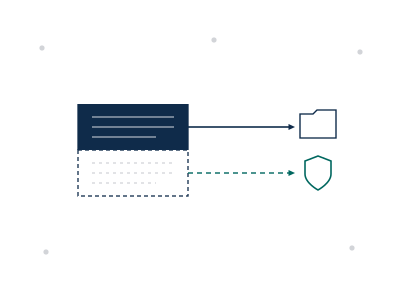
Since then, a case can end in one of two ways. On the short route, the STSB establishes the facts in a preliminary investigation, assesses the prevention potential and publishes an anonymised factual summary in its quarterly Prevention Bulletin. On the long route, it opens a full investigation that ends with a final report: facts, analysis, conclusions, recommendations. Which route a case takes depends on its prevention potential. Investigations already under way are also being reassessed and may be closed with a factual summary.
An Obvious Objection
There is an obvious objection to this criterion. How much can be learned from a case only becomes clear once it has been investigated. Yet the STSB assesses prevention potential during the preliminary investigation, before the actual analysis begins.
The objection does not apply to the STSB alone, however, because the formula is not its own. ICAO Annex 13 has stated for decades that the extent of an investigation is determined by the investigation authority “depending on the lessons it expects to draw from the investigation for the improvement of safety”. The European regulation on accident investigation, which also applies to Switzerland through the Air Transport Agreement with the EU, adopts this almost word for word. The STSB is applying an internationally established criterion.
What can be examined is how the STSB applies it. The STSB could disclose how often a case was moved to the long route after all, following the preliminary investigation. That one figure would show whether the prioritisation works in both directions, in other words whether cases that looked unremarkable at first still end up being investigated in depth.
What Remains When the Analysis Is Dropped
For the exemption, what matters more is what the short route produces and what it does not.
A final report consists of two very different parts. One records what happened. The other explains under which conditions the actions of those involved made sense, and addresses recommendations to organisations and authorities. ICAO recognises this difference. In Appendix 2 to Annex 13 it recommends that states allow “the use of factual information” but keep “analysis, conclusions and safety recommendations” out of proceedings aimed at apportioning blame.
Switzerland has never introduced this separation. The Federal Council’s dispatch on the revision states plainly that accident investigation records may be used in criminal, administrative criminal or administrative proceedings, and that even a report to the STSB can therefore trigger such proceedings. In the consultation, the aviation sector called for the new protection for occurrence reports to be extended to reports made to the STSB. The Federal Council declined and wants to gather experience first.
Set this next to the prioritisation and the fit is uncomfortably exact. The short route produces the facts, but no analysis, no conclusions, no recommendations. What remains is exactly the part ICAO considers usable, and what is missing is exactly the part it wants to protect. The point here is not the anonymised bulletin entry but the preliminary investigation file, which can be used in criminal proceedings. An example: that the take-off mass was exceeded can be recorded in a few lines. Why it was exceeded that morning, who should have noticed and which procedure made it more likely are then recorded nowhere. Facts without their conditions read like a finding against a person.
None of this is intentional. It is a side effect, and nobody notices it because the two developments are handled in separate policy areas.
The Gap in the New Law
The dispatch also explains why cooperation with the safety investigation in particular justifies the exemption. It defines official safety investigations as investigations into the technical, operational, human, organisational and systemic causes and circumstances of an occurrence. If no such investigation takes place, the dispatch says, there is also no “systemic contribution to prevention that is always publicly accessible”, and so no exemption applies.
So the dispatch recognises only two states: investigated or not investigated. The short route in between does not appear anywhere in its 86 pages. The STSB, for its part, explicitly counts it as a safety investigation. Every accident, it says, becomes the subject of a safety investigation “consisting at least of a preliminary investigation and a factual summary published promptly in the Prevention Bulletin”. The two authorities do not mean the same thing by the same word.
For the accused, this means it is an open question whether cooperating with a preliminary investigation counts. In the STSB’s terms, they have cooperated with a safety investigation. The reasoning of the dispatch, however, points the other way, because a factual summary does not provide the systemic contribution to prevention on which the dispatch bases the exemption. Someone who has cooperated does not know whether it will help them.
On 16 September the Council of States debated precisely the clause on cooperation. Heidi Z’graggen, a member of the Council of States, moved to delete it and to make the exemption depend on minor culpability alone. Making cooperation a condition, she argued, turns it “into an instrument of criminal-law pressure”, which would reduce people’s willingness to report. Federal Councillor Albert Rösti, whose department covers transport, countered that anyone who acts negligently must make the effort “to cooperate with the Swiss Transportation Safety Investigation Board (STSB) in order to clear up the case”. The chamber sided with him by 32 votes to 8. Both sides assumed that the case would actually be investigated and cleared up.
What applies when there is only a preliminary investigation was not asked in this debate either. Yet it also decides how a reasonable effort is to be measured. The dispatch explicitly leaves this to be worked out in practice by prosecutors and courts, and indicates that the accused will have to demonstrate the efforts they made. So they are to prove that they cooperated with something whose scope an authority sets according to its own priorities.
There is a second form of protection in the revised Aviation Act. Anyone who reports an occurrence will not be prosecuted if the authorities learned of it solely through that report. In aviation, though, it will rarely apply, and the dispatch itself concedes as much. The Office of the Attorney General, which will in future handle criminal proceedings after aviation accidents, learns of most cases by other means, and occurrence reports play only a minor role in criminal proceedings. What remains in practice for the accused is the new third paragraph. And it depends on an investigation that no longer takes place in every case.
What Follows
I consider each of the two developments defensible on its own. An authority that can no longer complete its investigations in good time has to prioritise, and it says so openly. That is worth more than an assurance that everything is carrying on as before. And a parliament that rewards cooperation instead of punishing it is doing something right.
The problem arises only from the combination, and it is a design flaw, not anyone’s failure. Anyone who ties legal protection to cooperation with a procedure has to make sure that the procedure takes place and that it delivers what was used to justify the protection. Otherwise the result is a promise whose fulfilment depends on a resourcing decision over which the protected person has no influence.
The law can no longer be corrected on this point. What remains open is who decides whether cooperation with a preliminary investigation is enough. As the new paragraph is constructed, it is the criminal justice authorities, case by case, long after the investigation board has decided how much investigation there will be.
Nor has this revision introduced the separation that ICAO has recommended for years: distinguishing in the report between what happened and what explains it, and leaving only the former to criminal proceedings.
As long as that separation is missing, an uncomfortable situation remains. The analysis that explains people becomes rarer. The facts that may incriminate them are available sooner. And the provision meant to protect them depends on the rarer of the two.
Quotations from German-language sources are my own translation.
Thoughts on this? Take it to LinkedIn.
No comments here – but discussion is welcome, where the readership is anyway.
Join the discussion on LinkedInSources
- ICAO – Annex 13 to the Convention on International Civil Aviation: Aircraft Accident and Incident Investigation, 11th ed. 2016 (main source)
- Regulation (EU) No 996/2010 on the investigation and prevention of accidents and incidents in civil aviation, consolidated version (main source)
- Schweizerischer Bundesrat – Botschaft zur Änderung des Luftfahrtgesetzes, 12 November 2025 (main source)
- UVEK – Änderung des Luftfahrtgesetzes: Ergebnis des Vernehmlassungsverfahrens, April 2025
- Agreement between the European Community and the Swiss Confederation on Air Transport, SR 0.748.127.192.68
- Schweizerische Sicherheitsuntersuchungsstelle SUST – Faktenberichte und Einstellungen von Sicherheitsuntersuchungen Aviatik, notice of 24 December 2025
- Amtliches Bulletin der Bundesversammlung – Ständerat, Herbstsession 2026, sitting of 16 September 2026, item 25.086