
A captain at a European airline, asked in a survey about a moment when he should have stepped in, remembers that he did not. His reason: “I should probably have said something or taken over, but our CRM was good, we had a good team spirit and I just didn’t want to be the bad guy.”
The line comes from a study by Nadine Bienefeld and Gudela Grote at ETH Zurich. 1,751 cockpit and cabin crew members of the same airline took part, a response rate of 82 per cent. Every one of them had at least once felt the urge to raise a safety-critical observation. They raised it in 52 per cent of those situations, and in the other 48 per cent they stayed silent. The airline had a long-established just culture and CRM training above the industry standard.
The reasons are the interesting part. Status anxiety plays a role, but it does not head the list. Across the occupational groups the most common reason was concern about damaging relationships and disturbing the climate in the team. Among captains, 53 per cent named it. Bienefeld and Grote call the result pseudo harmony and write that CRM training may have succeeded too well: crews have been taught for three decades how much an open climate matters, and some of them now suppress dissent in order to protect it.
Anyone who treats psychological safety as another word for a good climate has a problem with that finding. The misunderstanding does not come from the book that carried the term into management. It arose in the quoting.
The finding that pointed the wrong way
The Fearless Organization condenses twenty years of research that began in 1996 with a doctoral project that failed. Amy Edmondson was then attached, under Richard Hackman at Harvard, to a large study of medication errors in two hospitals. Her own task was small: hand out a survey on team quality, then wait six months while the nurses collected the error data. Her hypothesis came from aviation and was unremarkable. Better teams make fewer errors.
The correlation was significant and pointed the wrong way. The better teams had the higher error rates. In Right Kind of Wrong, Edmondson describes sitting in front of the screen working out how to break it to Hackman.
Her reinterpretation became the construct: perhaps the good teams do not make more errors, they report more of them. Two pieces of evidence supported it. First, she had added a question of her own to the survey, “If you make a mistake in this unit, it won’t be held against you”, and that item correlated with the recorded error rates. Second, she sent an assistant onto the wards who knew neither the error data nor her hypothesis. His ranking, ordered by how openly people talked there, matched the recorded error rates almost exactly.
That insight took the main study down with it. The study had set out to establish the actual rate of medication errors in two hospitals, and its figures were no good for that: where people could not disclose an error, the error stayed invisible. For any reporting culture, this by-product weighs more than the question the study started with. A department with strikingly few reports is, for now, only one thing: striking.
Comparing reporting figures across departments compares two things at once: what happens, and how willing people are to talk about it.
In 1999, in Administrative Science Quarterly, Edmondson gave it a name and a definition: a shared belief held by members of a team that the team is safe for interpersonal risk taking. Not a personality trait, not a comfortable feeling, a property of the group. It says something about what a person risks by asking an awkward question. The construct has held: the meta-analysis by Frazier and colleagues covered 136 independent samples with more than 22,000 people and found stable relationships with work behaviour and performance.
Four quadrants, and only one is learning
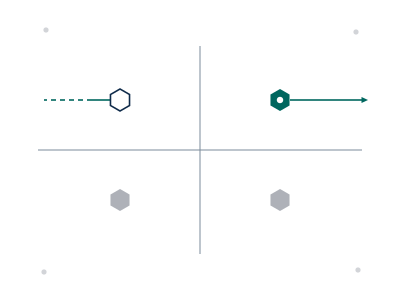
The most useful part of the book is a matrix that almost always drops out when the book is quoted. Edmondson crosses psychological safety with performance standards, with how high the bar sits in the team.
| Low standards | High standards | |
|---|---|---|
| High psychological safety | Comfort zone | Learning zone |
| Low psychological safety | Apathy zone | Anxiety zone |
The top left is the field this book note is about. In the comfort zone people talk, and nothing follows from it. The captain who kept quiet so as not to spoil anyone’s day was sitting there, with no ill intent at all. “You can say anything here” proves nothing on its own: it describes two fields at once, and only one of them is the one you want.
What the book leaves open
It is a leadership book. Almost everything runs through what the leader does: framing the work, inviting participation, responding productively to bad news. That is right, and it is not enough. In the ETH survey, 70 per cent of pursers, the cabin crew leads, named the conflict between efficiency and safety as a reason for their silence, and 41 per cent named time pressure. One of them puts it plainly: “We all know that when it comes down to business, all that counts is on-time departures.” Those conditions are not set in the team. They are set at the blunt end, in rosters and incentives. Leaving them untouched and working on conversational culture instead asks the sharp end to absorb a conflict of goals personally.
Second, measurement. Frazier and colleagues note in the same meta-analysis that their studies are predominantly cross-sectional, so the direction of causality stays open. The home-made version of the problem matters more in practice: once psychological safety becomes a number in the employee survey, it measures what people are willing to put in an employee survey.
Third, the cases. Volkswagen and Fukushima are in the book because we know how they ended. Cases picked in hindsight illustrate well and prove little.
Who this book is for
Anyone who leads a team and needs a vocabulary for something they have felt for a long time. The book is well written, and it says itself what psychological safety is not: not an environment where anything goes, and not being comfortable at work. Anyone who wants to measure it should go to the 1999 paper and the meta-analysis.
The most useful test, though, is not in the book. It is in the ETH study. Do not ask your team whether people can say anything here. Every room answers yes. Ask when someone last said something that spoiled another person’s day. And what happened afterwards, to the matter and to the person.
Thoughts on this? Take it to LinkedIn.
No comments here – but discussion is welcome, where the readership is anyway.
Join the discussion on LinkedInSources
- Amy C. Edmondson – The Fearless Organization: Creating Psychological Safety in the Workplace for Learning, Innovation, and Growth, Wiley 2018 (main source)
- Amy C. Edmondson – Psychological Safety and Learning Behavior in Work Teams, Administrative Science Quarterly 44(2), 1999, pp. 350–383
- Amy C. Edmondson – Learning from Mistakes Is Easier Said Than Done: Group and Organizational Influences on the Detection and Correction of Human Error, Journal of Applied Behavioral Science 32(1), 1996, pp. 5–28
- Amy C. Edmondson – Right Kind of Wrong: The Science of Failing Well, Atria Books 2023
- Nadine Bienefeld & Gudela Grote – Silence That May Kill: When Aircrew Members Don’t Speak Up and Why, Aviation Psychology and Applied Human Factors 2(1), 2012, pp. 1–10
- M. Lance Frazier, Stav Fainshmidt, Ryan L. Klinger, Amir Pezeshkan & Veselina Vracheva – Psychological Safety: A Meta-Analytic Review and Extension, Personnel Psychology 70(1), 2017, pp. 113–165