
On the evening of 13 January 2012, the Costa Concordia turned closer to the Tuscan island of Giglio than any chart allowed. It was a salute. An illuminated cruise ship was to pay its respects to the island in passing, a picture for the residents and for the guests aboard. At 21:45 a rock on the Scole reef tore a gash more than fifty metres long into the hull. More than 4,200 people were aboard. 32 of them died.
The story that grew out of this is one of the best-known captain’s stories of recent decades: Francesco Schettino, the man who sailed too close, who played down the situation, who left his ship while passengers were still aboard. In 2015 he was sentenced to sixteen years in prison. The case has a face, a name and a verdict. That is exactly what makes it so seductive as a lesson, and so useless.
Anyone who reads the Concordia as the story of one individual skips the question that matters for every other organisation. The interesting question is not why this captain decided as he did that evening. It is: why was the manoeuvre he performed available at all? Why was there a rehearsed, named ritual that only had to be pushed one notch further?
A Salute With a History
The manoeuvre has a name in Italian seafaring: the inchino, the bow. A ship passes close to a coast, greets with its horn, shows itself off. For cruise lines this was not a lapse. It was a marketing device: attractive images, satisfied guests, and a salute to the home island of a distinguished captain. The Concordia herself had already saluted Giglio in August 2011, in daylight, during an island festival, and that pass had been approved by the line.
Schettino later testified that management had actively wanted such manoeuvres. “Sail past there, sail past there” had been the message, it went down well with passengers. This statement has to be read with caution, it comes from a man fighting for his own defence. But it does not stand alone. The human factors researcher Nippin Anand, who interviewed Schettino over four days in Sorrento in 2017, places the inchino in a market that rewarded it: between 2003 and 2013 worldwide cruise demand grew by roughly 77 per cent, capacity in the Mediterranean at times by up to 160 per cent. Officers were promoted faster than experience could grow. In a field like that, the close pass is no private whim. It is a currency.
How Deviance Becomes the Norm
Diane Vaughan coined a term for this pattern when she investigated the Challenger disaster: the normalization of deviance. A departure from the safe standard goes well once. The next time it is already less conspicuous, because it was harmless the last time. After enough repetitions the deviation itself has become the norm, and the original standard looks over-cautious. No one ever decided to increase the risk. The risk grew through a series of small steps, each defensible on its own.
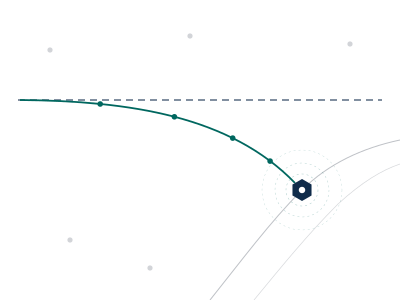
Applied to the inchino practice this means: every pass that went well shifted the boundary of the acceptable a little closer to the coast. The distance that was safe last time becomes the benchmark for next time, and a bit closer is always possible. There is no threshold at which an alarm sounds, no moment at which someone would have to say: this far and no further. Sidney Dekker calls this the real trap in Drift into Failure. Accidents of this kind do not arise from rule-breaking by the reckless. They arise because ordinary people, under pressure to be efficient and competitive, make a series of locally sensible decisions. Every single pass was explicable. Their sum was a practice heading for a rock.
No one ever decided to increase the risk. The risk grew through a series of small steps, each defensible on its own.
The Man Left Holding the Blame
None of this makes the decision of 13 January right. Schettino sailed at night, in poor visibility, at 15.5 knots towards a poorly lit coast, on a route that was not the programmed one. The official report of the Italian Marine Casualties Investigative Body names the captain’s conduct as the main cause, and the concrete chain that evening, from the late course correction to the chaotic evacuation, hangs on him. Individual responsibility does not dissolve into the systemic explanation.
What is telling is what happened after the disaster. The practice that had rewarded the inchino receded into the background. The line stressed that the 2012 route had not been the intended one. What remained was a captain, a verdict, sixteen years. This is the moment I keep seeing in my own working life, on a smaller scale: a system that has tolerated and exploited a deviation for years finds, remarkably quickly after the damage, the one person who took the last step. The culprit is convenient because he closes the case. Once the case has a name, no one has to touch the practice.
Anand calls this reflex scapegoating, and he does not mean that Schettino was blameless. He means that fixating on the individual ends the learning. This is the point where the New View is not gentler but more demanding than the old one. It does not let the acting person off the hook. It simply refuses to stop at them.
What This Says About Drift
Drift has no villain and no moment at which it is decided. That is exactly what makes it dangerous, and exactly what makes the question of blame afterwards so tempting. It supplies both in hindsight: a face and a point in time. The Concordia is a large, deadly case. The mechanism behind it is everyday, and it runs in maintenance intervals, in approval processes, in safety margins just as much as on a ship’s bridge.
So the uncomfortable question is not whether you have a Schettino. It is which deviation in your organisation is quietly becoming a matter of course right now, because it has gone well every time so far. It does not announce itself. It waits for the rock.
Thoughts on this? Take it to LinkedIn.
No comments here – but discussion is welcome, where the readership is anyway.
Join the discussion on LinkedInSources
- Sidney Dekker – Drift into Failure, Ashgate 2011 (main source)
- Diane Vaughan – The Challenger Launch Decision, University of Chicago Press 1996 (normalization of deviance)
- Nippin Anand – Are We Learning from Accidents?, Novellus 2024 (the systemic reading, Schettino interview)
- Marine Casualties Investigative Body (Ministero delle Infrastrutture e dei Trasporti) – Cruise Ship Costa Concordia: Report on the Safety Technical Investigation, 2013 (official investigation report)