
Reliability sounds like a state. An organisation works towards it, reaches it, and then has it, certified on paper. In Managing the Unexpected, Karl Weick and Kathleen Sutcliffe describe something different. For them reliability is not something you have, but something you do, and it ceases to exist the moment you stop doing it. That is the uncomfortable point of a book that is often read as a recipe and actually describes a permanent task.
What the book does
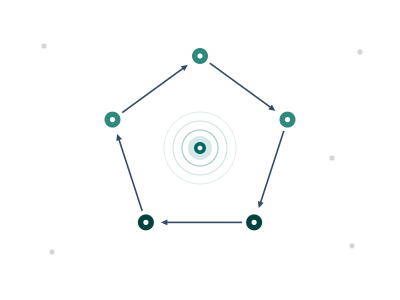
The book distils what the Berkeley research of the late 1980s observed on aircraft carriers, in nuclear power plants, and in air traffic control: organisations that operate under unforgiving conditions and still produce remarkably few catastrophic failures. Weick and Sutcliffe capture their behaviour in five principles, gathered under the term “mindful organizing”. The first three serve anticipation, that is, looking ahead. The last two serve containment, that is, dealing with the error that occurs anyway.
Anticipation: reading the system before it breaks
Preoccupation with failure means treating near misses and small deviations as information about the state of the system, not as a nuisance to be cleared away. Where others read success as confirmation, High Reliability Organizations read it as a possible cover for drift, the slow, unnoticed departure of practice-as-done from the safe baseline.
Reluctance to simplify means distrusting the quick label. “We’ve seen this before” is the most dangerous diagnosis, because it ends attention before it has begun. Diverse viewpoints are deliberately kept open, even when that is uncomfortable.
Sensitivity to operations means holding attention at the front line, on work-as-done, not on the smoothed representation that arrives in the executive suite. Anyone who knows operations only through reports does not see the weak signals.
Containment: the moment it goes wrong anyway
Commitment to resilience means accepting that no system is error-free, and training the ability to detect errors early, contain them, and recover from them before they escalate.
Deference to expertise means that decisions migrate to the person with the most relevant knowledge, regardless of rank. The classic image comes from the flight deck: there, the most junior observer can wave off a landing, and nobody asks first about their place in the org chart. There is an important qualification that often gets lost in practice: this is about exceptional situations, not normal operations. Read as a general suspension of line authority, the principle rightly meets resistance. In everyday work the line decides; in the critical moment, expertise does.
For Weick and Sutcliffe, reliability is not a state you reach and then own. It is an activity that ceases to exist the moment attention does.
Three editions, and why “sustained” says more than “resilient”
The subtitles of the three editions tell a story of their own. In 2001 the book’s subtitle was “Assuring High Performance in an Age of Complexity”. In 2007 it became “Resilient Performance in an Age of Uncertainty”, at the same time as the rise of Resilience Engineering around Hollnagel, Woods, and Leveson. In 2015 “resilient” disappeared again and made way for “Sustained Performance in a Complex World”.
So the arc does not run in a straight line into resilience. It reaches a peak there and steps back again in 2015. One can speculate whether that has to do with the dilution the word “resilience” underwent in those years. The subtitles alone do not prove it. But “sustained” carries a meaning that “resilient” does not: something is kept up, continuously, or it is not. That is closer to what the book says anyway than the quality “resilient” implies.
Why “mindful organizing” is the real core
The five principles lend themselves to being read as a checklist, and on countless consulting slides that is exactly what happens. The book argues against precisely this. “Mindful organizing” is a collective attention, an ongoing practice, not a state you install and then have. A checklist you tick off. A practice you keep up or lose.
This has an uncomfortable consequence. An organisation can show green on all five principles in an audit and have lost the actual practice a month later, because that practice does not live in the binder but in everyday work: in how a shift lead responds to a weak signal at three in the morning, and whether a near-miss report draws a thank-you or a raised eyebrow.
What this means in practice
Mindful organizing cannot be rolled out as a programme. It shows in the small things, in whether “we’ve had this before” ends a discussion or opens one. And the third edition’s claim that this logic carries beyond aviation and nuclear power holds: every organisation that deals with complexity, from the hospital ward to the consulting team under deadline, organises more or less mindfully. The principles are a diagnostic tool, not a rule. They tell you what to look at, not which form to fill in.
What the book leaves open
Weick and Sutcliffe reconstruct their virtues from organisations that succeeded. That is selecting on the outcome, and it has a price: the book shows convincingly what mindful organizing looks like, but little about how you get there when incentives, budget pressure, and hierarchy pull the other way. The destination is described vividly, the gravity against it barely at all. For practice, that is the real gap: knowing that deference to expertise is good does nothing for the manager whose bonus depends on not stopping the line.
Power and economics barely appear either: who holds sway in the operation, and whose budget a measure costs, stays largely out of view.
Who this book is for
At bottom it is worth reading for anyone who deals with complexity, and that is nearly every organisation. But most of all for those who are operationally accountable for reliability: safety leads, operations managers, leaders in healthcare, aviation, and industry, and consultants who work with HRO vocabulary. Do not read it as a maturity model. Read it as the description of a practice you run, or lose, every day. And above all it is worth reading for anyone tempted to pour the five principles into an audit checklist. That is exactly what the book argues against – if you read it closely.
Sources
- Karl E. Weick & Kathleen M. Sutcliffe – Managing the Unexpected: Sustained Performance in a Complex World, 3rd ed., Jossey-Bass 2015
- Karl E. Weick & Kathleen M. Sutcliffe – Managing the Unexpected: Resilient Performance in an Age of Uncertainty, 2nd ed., Jossey-Bass 2007
- Karl E. Weick & Kathleen M. Sutcliffe – Managing the Unexpected: Assuring High Performance in an Age of Complexity, 1st ed., Jossey-Bass 2001
- Todd R. La Porte & Paula M. Consolini – Working in Practice But Not in Theory: Theoretical Challenges of High-Reliability Organizations, Journal of Public Administration Research and Theory 1991