
On Friday at 15:54 Eastern Time, US air traffic control halted every departure in the country. The FAA’s order cited “extraordinary circumstances” and “reasons of safety”; its statement referred to communication issues at several en-route centres, which the FAA calls Air Route Traffic Control Centers. The stop was lifted a little over four hours later. When it was issued, more than 3,500 aircraft were in the air. It was the third nationwide ground stop in US history, after 11 September 2001 and the failure of the NOTAM system in January 2023.
Why it happened is still unclear. The FAA is investigating, and I will not speculate about the cause. This piece is about the measure itself.
The Barrier Held
The coverage called it chaos: thousands of cancelled flights and passengers stuck in terminals. From a safety perspective, something else needs saying first. A system that no longer had enough confidence in its own operational picture brought itself to a stop. Aviation has an advantage here that many high-risk domains lack: it has a safe state it can move to. An aircraft on the ground does not depend on communications that cannot be trusted at that moment. A power grid or an intensive care unit has no equivalent.
The FAA itself spelled out this logic last time. In January 2023 it paused all domestic departures “to allow the agency to validate the integrity of flight and safety information”. The stop buys time to restore confidence in the system’s own information. Anyone who keeps sending traffic into the system in that situation is betting that the picture will turn out to be right.
The ground stop, however, only protects those still on the ground. For the more than 3,500 aircraft in the air there was no safe state other than the end of their flight, and they had to land in the very system that was no longer trusted enough to take new departures. The barrier keeps new traffic out. The system itself has to cope with the traffic already inside.
Two Airports, Then All of Them
The barrier worked, and yet an uncomfortable question remains. Before the whole country was brought to a halt, the FAA had imposed ground stops at Chicago’s two airports, O’Hare and Midway, at 14:10 and 14:17 local time, citing an “equipment outage”. Less than 45 minutes passed between a stop for two airports and a stop for all of them. Whether there were further steps in between, and why they were not enough, is a question for the post-event review.
In Normal Accidents (1984), Charles Perrow described a contradiction that applies here. Systems that are both complex and tightly coupled make opposing demands on their organisation. Tight coupling calls for centralised decisions, because processes are fast and only the top level sees the state of the whole system. Complexity calls for decentralisation, because unexpected interactions are best understood where they occur. Perrow explicitly counted air traffic control among the systems he examined.
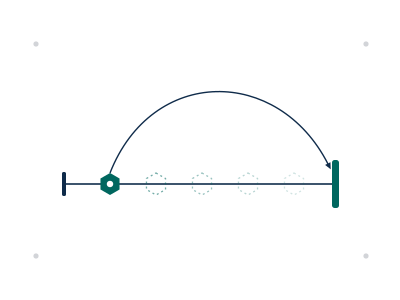
A nationwide ground stop is the purest form of a centralised decision: one order, every airport. It is the right call when nobody lower down the chain can reliably say what still works. In the moment of the disruption nothing is negotiated, a procedure takes over, and if that is the price of safety, it gets paid. Which steps that procedure offers is settled long beforehand. Being able to stop makes a system safe. Having steps between full operations and a standstill gives it more room for manoeuvre.
The ground stop only protects those still on the ground. For the more than 3,500 aircraft in the air there was no safe state other than the end of their flight.
What 2023 Showed
In the previous case, the cause has been made public. According to the FAA’s preliminary review, contract personnel had unintentionally deleted files while working to correct the synchronisation between the live primary database and its backup. Citing a source familiar with the FAA’s operations, CNN reported at the time that a corrupt file was also found in the backup system. Redundancy that shares the state of the primary system does not provide an intermediate option. It provides a second copy of the same problem, and all that remains is a standstill.
I do not know whether anything similar was at play on Friday, and I am not suggesting it was. The 2023 case shows only where one might look for intermediate steps, and why a copy of the primary system is not one.
The number of cancelled flights measures the price of the barrier. How many steps there are between “everything running” and “everything stopped” measures something else. Anyone who has defined a safe state for their own organisation can ask the same question, along with the second one that Perrow raises. Who is allowed to trigger the steps in between: headquarters, or the unit that sees the problem first?
Thoughts on this? Take it to LinkedIn.
No comments here – but discussion is welcome, where the readership is anyway.
Join the discussion on LinkedInSources
- Federal Aviation Administration – FAA Statement on Nationwide Ground Stop, 13 November 2026 (main source)
- Associated Press – Flights halted at airports across U.S. due to unspecified ‘extraordinary circumstances,’ FAA says, 13 November 2026
- CNN – Some US flights resume after hours-long ground stop, live coverage, 13 November 2026
- FOX 32 Chicago – FAA lifts nationwide ground stop; O’Hare, Midway flight delays improving, 13 November 2026
- Federal Aviation Administration – FAA NOTAM Statement, 11 and 19 January 2023
- Gregory Wallace & Pete Muntean – A corrupt file led to the FAA ground stoppage. It was also found in the backup system, CNN, 12 January 2023
- Charles Perrow – Normal Accidents: Living with High-Risk Technologies, Basic Books 1984 / Princeton UP 1999 (main source)