
The world today is highly complex and fast-changing. New technologies become available and change the way we work, communicate and live our lives. The complex socio-economic and socio-political systems can make it difficult to anticipate the needs and requirements of tomorrow. This article discusses issues organisations have to deal with and the benefit of becoming more human-centred with the help of a model aiming to influence organisations on policy level.
A changing world
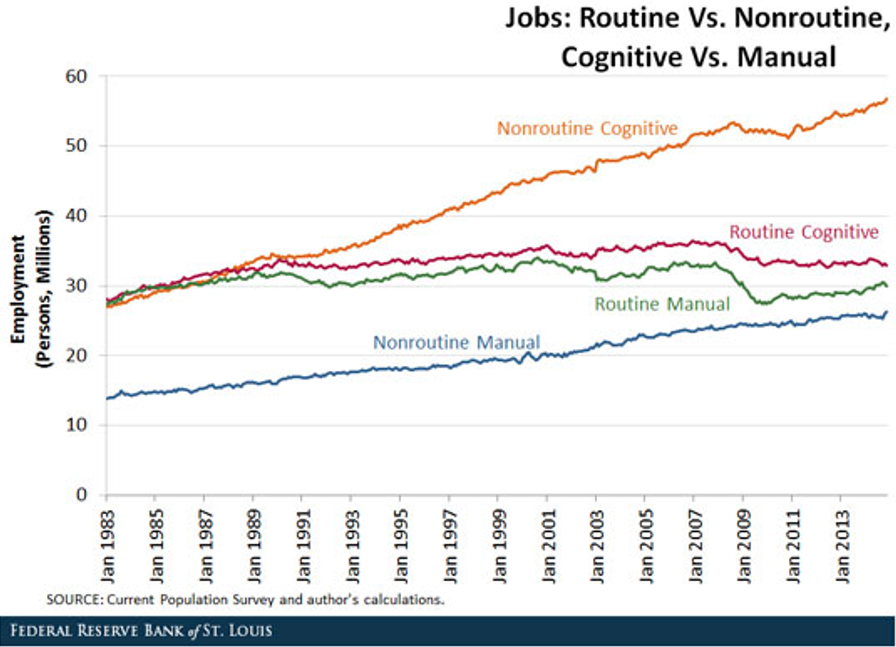
The introduction of new technologies, automation in particular, has shifted the nature of work and made certain tasks performed by personnel obsolete. This becomes more obvious when we look at how tasks have changed over time. Routine work of a cognitive and manual nature has decreased. However, non-routine work of both categories, but especially cognitive non-routine tasks, has increased greatly over the last 30 years, as illustrated in the following chart:
Being able to adapt and evolve in a sustainable way requires a workforce that is diverse and skilled and able to deal with complex problems. To accommodate this, frameworks are needed that could give guidance on how organisations can use their human resource in a better, more human-centred way.
Management
The aim of management is to maximise profits made by the company which in turn increases shareholder value. This is true today as it was back in the early 20th century when Scientific Management (Taylor 1911) was first introduced in manufacturing, particularly in the steel industry, to increase productivity and reduce costs.
Industries have to adapt to changes in demand and the development of new technologies at an ever-increasing rate. This is creating complex problems that must be confronted each day anew (Scott Page, 2011).
The constant demand on organisations to cope with complexity brings the need to develop better strategies and to become smarter. However, decision making, in many cases, depends on the knowledge and wisdom of few people with potentially limited understanding of the problem and no time to gather additional information. The knowledge and wisdom of experts is often not used or dispersed within the organisation, and difficult to access and unknown to decision makers.
One reason for this could be the process of employment, and that the criteria for the job are regularly narrowed to a set of specific requirements, ignoring the whole remit of a person’s skills and knowledge and how he or she could add value to the team under changing circumstances. On the other hand, personnel who proactively volunteer their expertise outside their defined job description are often seen as rebels or troublemakers and discouraged from contributing.
Frederick Winslow Taylor, in the early 1900s, described the good worker as someone whose job was to “just do what he was told to do, and no back talk.”
– James Surowiecki, The Wisdom of Crowds, 2004
Employees
The struggle of an organisation to change and adapt is often blamed on their employees, and most managers know the difficulty in convincing them of the necessity for the company to adapt.
Employees may already be conditioned to simply perform the job they were hired to do, and in many cases, they are happy knowing exactly what is expected of them with no need for further development of their skills and education. Others see the issues which make work difficult, but their suggestions are not taken into consideration and they become frustrated.
The view that a good worker is one that just does as he or she is told with no back talk is still present in today’s work environment, regardless of the nature of the job. If, however, employees are suddenly expected to embrace a new way of working, it is not surprising when they respond with scepticism and appear apathetic and unwilling to engage.
In fact, this very issue was observed by Frederick Winslow Taylor during the introduction of scientific management (Taylor 1911) in the early 20th century, and that was a time when change was less rapid than it is today.
In fast-changing environments, it becomes all the more difficult to precisely specify roles and responsibilities across a diverse set of jobs.
– Royal & Agnew, The Enemy of Engagement, 2012
ISO 27500 – Human-Centred Organisation
As illustrated previously, the need to constantly adapt to a changing environment is of vital importance for organisations in ever more dynamic economic environments. Often how work is done needs to change, which can mean that new technology needs to be introduced. New technology may impose the need for employees to adapt, which can have a tremendous impact not only on employees but also on customers. Therefore, it is important to anticipate the impact of new technology on human behaviour and to consider a human-centred approach not only on design but also on the wider organisation.
Many standards have been developed to address ergonomic and human factors requirements. These mainly address specific issues and focus on the technical side of human interaction with technology. However, the rapid pace of technological development makes it difficult to keep up to date with standards. This led to the development of Human-Centred Design standards which are not technology specific but focused on who the design was for and what their needs for the product and systems are (Tom Stewart, 2017). In 2016 a new ISO standard was introduced focusing on the human-centred organisation – general principles.
ISO 27500 is a “Hearts and Minds” standard aimed at corporate boards and at influencing policies. It consists of seven top-level principles. Each one has been endorsed by successful companies. It lays the foundation for application of ergonomics and human factors which not only address risk in terms of safety but can also improve quality and efficiency, and wellbeing.
ISO 27500 – Human-Centred Organisation provides principles that can help management with the process of becoming more human-centred. Below are some useful practical suggestions.
Capitalise on individual differences as an organisational strength. Having a diverse workforce should not be seen as a “must do thing” imposed by legislation or stakeholders, but a chance to improve resilience and performance within the organisation. People with different backgrounds think differently and make an organisation smarter. This should be reflected within human resource policies.
Adopt a total system approach. Understanding how the organisation works from a systems perspective helps in understanding its behaviour. This requires the organisation to take a closer look at feedback loops and make sure the flow of information is also going bottom-up. The application of system thinking can help to create better models of the dynamic processes relevant to the organisation. Try to understand the relationship between the different agents and components of the whole organisation. This can be achieved through applying methods which are able to model dynamic socio-technical systems.
Make usability and accessibility strategic business objectives. Application of a human-centred design process helps to understand users’ needs and provides a framework for engineering to design more usable and accessible products. Having systems in place that are usable and support optimal human performance will not only increase reliability but also reduce frustration within the workforce. Special attention should be paid to the distribution of information and how this is presented. Written information may not be ideal for a significant portion of the workforce.
Ensure health, safety, and wellbeing are business priorities. With more work being of cognitive non-routine nature, the focus should not only be on conventional safety but also on workload and mental health. Understanding the system and its constraints will help identify bottlenecks and be proactive in prevention of mental health issues.
Value personnel and create meaningful work. Do not consider employees as just another replaceable piece in the process and acknowledge their contribution. Their feedback might be of critical importance to the organisation. Attempt to understand the capability of your workforce and conduct a “what is already there” analysis to understand the variety of skills and competencies which are already available in the organisation. Finding a way to allow creativity to thrive increases the organisation’s ability to innovate and be more resilient to change. Listen to “rebels” carefully; what they have to say can be of critical importance. Create an environment where thoughts and ideas can be shared, and critical voices are valued.
Be open and trustworthy. Openly and transparently communicate difficult decisions and admit organisational shortfalls. Accept different views and critical feedback from employees. Make sure you have an effective way to collect opinions from stakeholders.
Act in socially responsible ways. This principle links to ISO 26000 which provides guidance on social responsibility. Social responsibility may depend on the cultural context the organisation is working in. If an organisation changes its operation from a regional or national to an international stage, the requirements may change rapidly.
Conclusion
ISO 27500 is currently not a certifiable standard, but this does not mean it should be ignored. The principles mentioned can provide a framework for policies and lay the foundation for a more sustainable utilisation of the human resource.
Organisations do not need to find a good reason to follow a standard; they need a good reason not to follow it.
References
- Frederick Taylor – The Principles of Scientific Management, 1911
- James Surowiecki – The Wisdom of Crowds, 2004
- Scott E. Page – Diversity and Complexity, 2011
- Mark Royal & Tom Agnew – The Enemy of Engagement, 2012
- ISO 27500 – The Human-Centred Organisation, 2016
- stlouisfed.org – Jobs involving routine tasks aren’t growing
- Tom Stewart (2016) – YouTube talk