
Tag: Old View

  • Field Guide to Understanding Human Error – a note on Sidney Dekker

    Field Guide to Understanding Human Error – a note on Sidney Dekker

    Sidney Dekker’s Field Guide to Understanding Human Error sits within reach of my desk, third edition 2014. It’s not the book I quote most often, but the one I most often return to. With every re-reading, what strikes me is how strange it is: written as a guide (subtitle, clear table of contents, plain language) and yet at its core a systematic attack on the standard way of reading incidents.

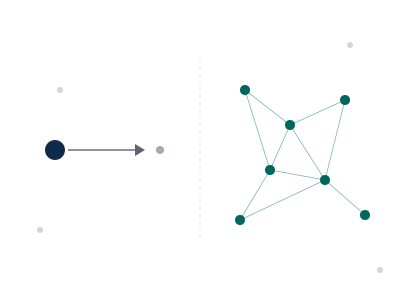
    Dekker’s core operation can be put in one sentence: he shifts the position of judgement – away from above with outcome knowledge, toward the view of those who stood in the moment of action. Old View, in his vocabulary, asks from the outside: who acted wrongly, who failed, who didn’t meet the standard? New View asks from the inside: what was visible, plausible, reasonable to the acting person at that moment, given what they saw, knew, and could put together? The shift isn’t a swap of tools. It’s a shift of the position from which judgement happens at all.

    Local rationality. Why “local” is the decisive adjective, not “rational” alone: every actor would be rational, every investigation tacitly assumes that anyway. The word “local” marks something else: the binding to a concrete horizon. Local means what the person could see, know, and combine in the moment, with the indicators in front of them, the pressure at their neck, the training in their head. Dekker’s standard move in the Field Guide is to reconstruct every “wrong” decision from this local horizon first. And the book shows this reconstruction as craft, through concrete incidents, often with transcribed radio logs or witness statements. Little theory, much workshop. In the back of the book there’s a structured question apparatus meant to help any investigation reconstruct local rationality: what did the person have in front of them, what didn’t they, which indicators spoke which language, which ones do they know from training, which resources were available at that moment. This turns a theoretical concept into a workable investigative discipline.

    Sharp End / Blunt End. The pair of terms comes from James Reason, and Dekker uses them consistently. Sharp End is whoever stood in the incident: the nurse at the bedside, the operator at the console, the pilot in the cockpit. Blunt End is what created the conditions under which Sharp End works: design decisions, rule sets, resource allocations, trade-offs between safety and speed. Dekker’s point isn’t that the Sharp End is innocent. It’s that most Sharp End actions are responses to Blunt End conditions. Whoever looks only at the Sharp End sees the hand on the lever. And misses the pressure that brought the hand there. And with it the only place where a correction would even be possible.

    “Causes don’t exist, you construct them.” Dekker’s sharpest provocation and most frequently misunderstood thesis. It doesn’t mean: everything is equal, everything is relative. It means: what we identify at the end of an investigation as “the cause” is always a selection from many contributing conditions. And the selection says something about the analytical lens we’re looking through. Which factor becomes “the cause” and which stays “context” is a decision of the investigation. A conscious one sometimes, an unconscious one mostly. Dekker’s invitation isn’t to arbitrariness. It’s to self-reflection: what are we doing when we identify a cause? What choice are we making without marking it as a choice?

    Causes don’t exist, you construct them.
    – Sidney Dekker

    What I read differently today

    What the book has shaped, after years of practice, can be named pretty precisely: better investigations, more context interviews before the question of blame, less reflex toward “employee sensitisation” as a recommendation. Dekker supplied the vocabulary with which I now turn down assignments where the answer is already prescribed. The limit I notice more strongly with every re-reading: the book is excellent at diagnosis, how to read incidents differently, how to conduct investigations more openly, how to deconstruct the reading reflexes of the Old View. It’s noticeably less explicit on the operational rebuilding question: how to actually build an organisation differently so the New View reading happens not only in investigations but in daily operations. Whoever looks for the next step after the Field Guide typically lands with Conklin (HOP, Pre-Accident Investigations, Operating Principles), more operational, closer to the shop floor. Dekker and Conklin together make the set: first the lens, then the tool.

    Who this book is for

    Required reading for anyone who investigates incidents or shares responsibility for them: safety officers, auditors, line managers in HRO-adjacent industries, investigation commissions of every kind. Especially for those who notice their investigations were over too quickly, without being able to name exactly why. The book gives the observation a vocabulary. If you read only one book on human error, read this one, not because it gives the most answers, but because it changes the way you ask questions.

    Sources

    • Sidney Dekker – The Field Guide to Understanding Human Error, 3rd ed., CRC Press 2014 (main source)
    • Sidney Dekker – Drift into Failure, CRC Press 2011
    • Erik Hollnagel – Safety-II in Practice, Routledge 2018
    • Todd Conklin – Pre-Accident Investigations, Ashgate 2012
    • James Reason – Managing the Risks of Organizational Accidents, Ashgate 1997 (for Sharp End / Blunt End)
  • The New View of Human Error

    The New View of Human Error

    In this article, I will focus on the Old View and the New View of human error. This is a first, short introduction, which lays the ground for further articles on this interesting topic.

    The term ‘New View’ is already 20 years old and basically not that new anymore. However, in many minds and subsequently in numerous organizations, the New View has not yet become established.

    Errors occur in every company. Fortunately, these mistakes usually have no consequences and often they are not even noticed. But unfortunately, sometimes there is financial impact or even personal injury.

    But why are these errors happening? Are these avoidable mistakes by individuals that should just have been more careful? Or are errors emergent properties of a complex socio-technical system and have little to do with the individual?

    The Old View

    One possible view is that human error and thus its negative consequence would be avoidable if everyone adhered to the rules. If an error occurs due to carelessness, it is sufficient to point this out to the person and, if necessary, to punish them, to solve the problem. In extreme cases, the punishment can go as far as to remove the culprit from the system. Criminal consequences are also conceivable. These are not necessarily initiated by the company, but in the case of ex officio offences by the prosecutor.

    The system itself is considered to be inherently safe. People in the system are seen as potential sources of error and system weakness. If all acting persons make an effort and adhere to the rules, nothing can actually happen. The safety level of the system can be measured by the number of incidents or accidents within a period.

    But how does this view help to make a system more secure?

    I am inclined to say: not at all. Companies are complex socio-technical systems. A characteristic of these systems is that not all effects of the interaction of different system components are known. Errors, but also system safety, are emergent system properties.

    But what is actually an error?

    We differentiate between different types of errors. There are the unintentional or unconscious errors that happen without knowing the effects on the system. And there are intended or deliberate mistakes. These are mostly deliberate deviations from existing procedures or rules. Such deviations occur, for example, in the event of conflicting goals, under high production pressure, or because no better alternatives are available. Thus, they are a result of inadequate systems. It is also often the case that these deviations have achieved better results for some time than official procedures.

    Whether an action was an error or not often has to do with the result itself. The term ‘error’ is therefore a backward-looking view of an action of which the result became known in the meantime. Especially in an environment with high complexity and incomplete information, it can happen that the same action leads to a positive result and another to a negative result. So whether someone made an error or not can be due to circumstances that were still unknown at that time.

    The New View

    The New View is distancing itself from the perspective of the human as a source of error and as the weakest link in the chain. Humans are seen much more as a system component that enables high system safety. The starting point is that people come to work to do a good job. If an error occurs, it cannot simply be reduced to the action of an individual. It is necessary to consider the error in the system context. Because the action that later turned out to be an error was considered by the acting person to be useful for achieving the goal at the time of execution.

    People make decisions under high pressure, with conflicting goals and in great uncertainty. In a complex system, decisions have to be made with incomplete information, or the amount of information is so large that it cannot be processed at all. This can lead to information being overlooked or deliberately not being included in decision making.

    Make the system safer

    In this context, I consider a system to be an organization or organizational unit with employees, technical systems and processes. If appropriate, the term system can also be extended to external components.

    Fortunately, as mentioned at the beginning, most errors remain without consequences. This is primarily due to people’s resilience and sometimes simply due to chance.

    Errors provide an opportunity to learn and make the system safer. If errors occur, it is not expedient to limit the analysis to the actions of the individual (the Old View). Removing the ‘culprit’ from the system does not improve it. It is crucial to take a system perspective in the analysis and to want to understand why the decision for this individual made sense in this specific situation (the New View). It must also be taken into account what information the person had available and what conflicting goals they were exposed to. This also raises the question of whether another – comparably competent – person might have made the same decision in a comparable situation or not. If this question is answered with ‘yes’, an adjustment in the system is required in order to achieve sustainable improvement.